Beyond the title: The role of coaching
15 years ago, I was hired as an Instructional Technology Specialist. I worked with teachers, helping them use the new technology our district was rolling out. My job included learning the new technology, providing training after school, and supporting teachers in the schools assigned to me. I was brand new to the district. I had never met the administrators or teachers of my assigned schools. The rest of my team were veterans of the district with well-established reputations. They were outgoing, fantastic trainers, and were way savvier when it came to learning new technology. I was a former middle school history teacher who liked using technology. I spent a long time feeling like they hired the wrong person for this role.
So, I went back to what I did best at my old school. For some reason, my colleagues liked to confide in me about the difficulties they were having, especially with using technology. The title of coach was never part of my job description, but I came to realize that’s exactly what I was, and I was really good at it.
There was no manual for me to study as a coach, nor should there be. There is a lot of minutiae involved when working closely with someone you don’t know well. Being a coach can mean different things depending on the context, but generally, a coach is someone who helps individuals or groups achieve their goals or improve their performance in a particular area. Achieving this can be challenging when the process of building trust is slow. How likely are you to listen to someone you barely know? Like teaching, coaching takes time for effective change to happen.
Whatever your title, if you are in a role that includes working closely with teachers to improve instructional practice and student outcomes, you are a coach, and building strong relationships is the most important part of being a coach.
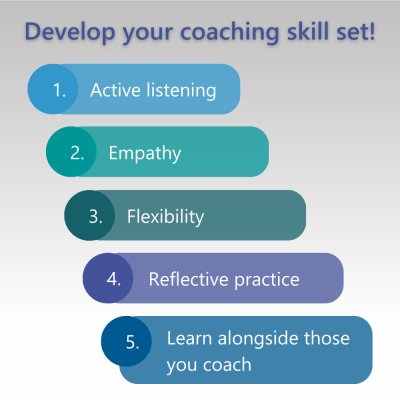
As you develop your coaching skillset, it is critical to include the following:
- Active listening: Who does the most talking when you are coaching? Coaches need to be fully present in the conversation without dominating it. Does the teacher being coached feel that you see them as equals?
- Empathy: Coaches need to be able to understand and relate to the experiences and perspectives of their teachers. Don’t assume that being a former classroom teacher automatically makes you empathetic in every situation. The key is to empathize without pity or judgement that can stall a teacher’s growth.
- Flexibility: Coaches need to be able to adapt to different situations and needs. Understand that your preferred method and frequency for coaching may not be aligned to those you are coaching. Be open to allowing for choice in how a teacher prefers to work with you.
- Reflective practice: Coaches need to be able to help teachers identify and overcome obstacles and challenges by taking time to reflect. Coaches also need to set aside time to reflect on their own practice.
- Learn alongside those you coach: It is not possible for even the most seasoned coach to have all the answers. Showing vulnerability isn’t a weakness. If we are asking teachers to try a new instructional practice or even scarier – new technology – in front of their students, coaches need to also be willing to take those same risks in front of those they coach.
To learn more about how you can utilize these and other coaching strategies to support teachers in educating students in an always-on, digital world, visit the i2e Certified Instructional Coach™ page and sign up for an upcoming webinar.
This blog was written by i2e CEO Dr. Kim West. Kim was a National Board-Certified K-12 educator, author, and content designer for professional learning. She is a Certified Clifton Strengths Coach. Kim has worked with Microsoft as a Fellow, Master Trainer, and is a Microsoft Certified Educator.